

The Ultimate VS Factory Audemars Piguet Royal Oak 15510 Review: The New Super Clone Standard


The Audemars Piguet Royal Oak 15510 represents the modern evolution of the iconic integrated bracelet sports watch, introducing refined dial aesthetics and a more ergonomic case design compared to its predecessor, the 15500. In the high-end replica market, recreating these nuanced changes has been a significant hurdle. Many factories took shortcuts, simply slapping new dials onto old 15500 cases and using unreliable movements.
VS Factory (VSF) has officially ended the compromise. With their brand-new, ground-up release of the Royal Oak 15510, powered by a specially customized V2 Dandong 4302 movement, VSF has redefined perfection. From correct lug tapering to dial texture transitions, let’s take a deep dive into why this new VSF release is the absolute apex of the AP super clone market.
📑 Table of Contents
- The Heart: Dandong 4302 V2 Movement & Rotor Details
- Dial Mastery: Grande Tapisserie, Colors, and Hands
- Case Geometry: True 15510 Tapered Lugs
- Bracelet Articulation & Clasp Engravings
- Final Verdict
1. The Heart: Dandong 4302 V2 Movement & Rotor Details
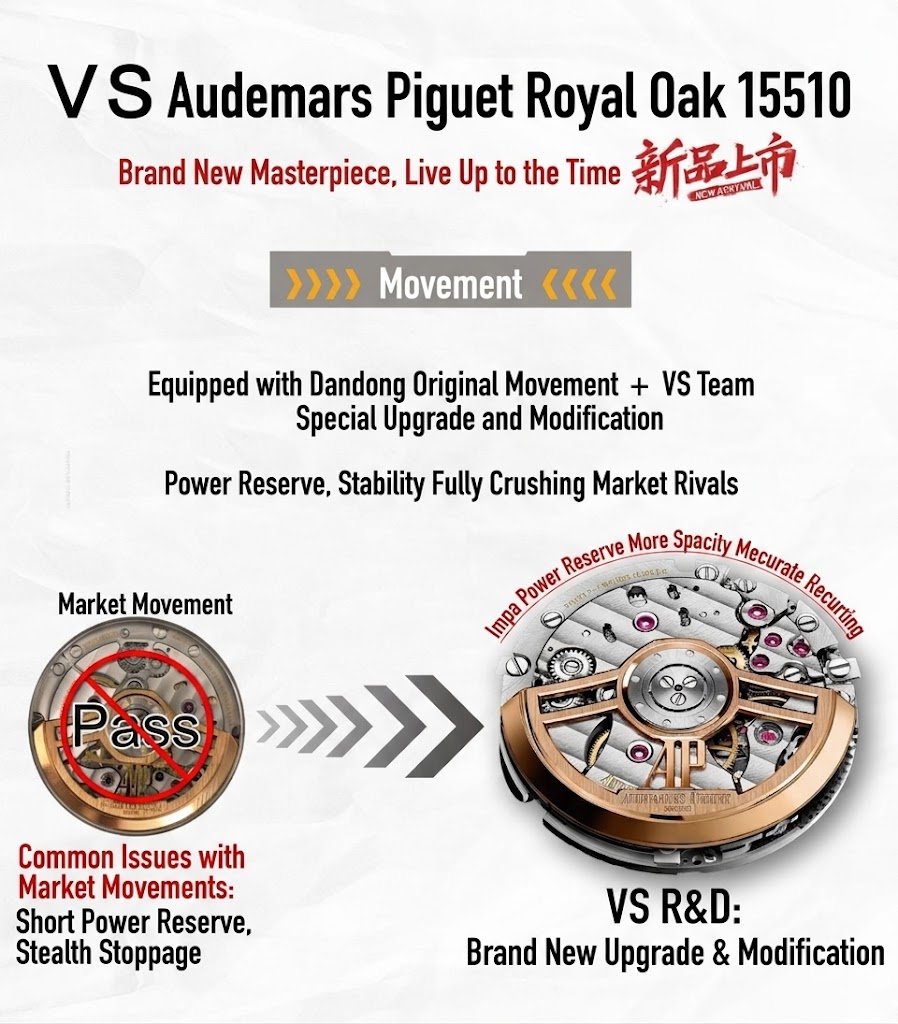
A super clone is only as good as its engine. Previous market versions of the 15510 suffered from notorious movement issues: short power reserves, random stopping (stealing time), and stuck calendar wheels. VS Factory has completely overhauled the mechanical architecture.
- Upgraded V2 Performance: The VSF team has custom-upgraded the Dandong 1:1 4302 caliber. It now boasts an incredible, rock-solid 72-hour power reserve, completely eliminating the stalling and date-wheel sticking issues that plagued older clones. The integration of ceramic ball bearings ensures incredibly smooth and quiet rotor winding.
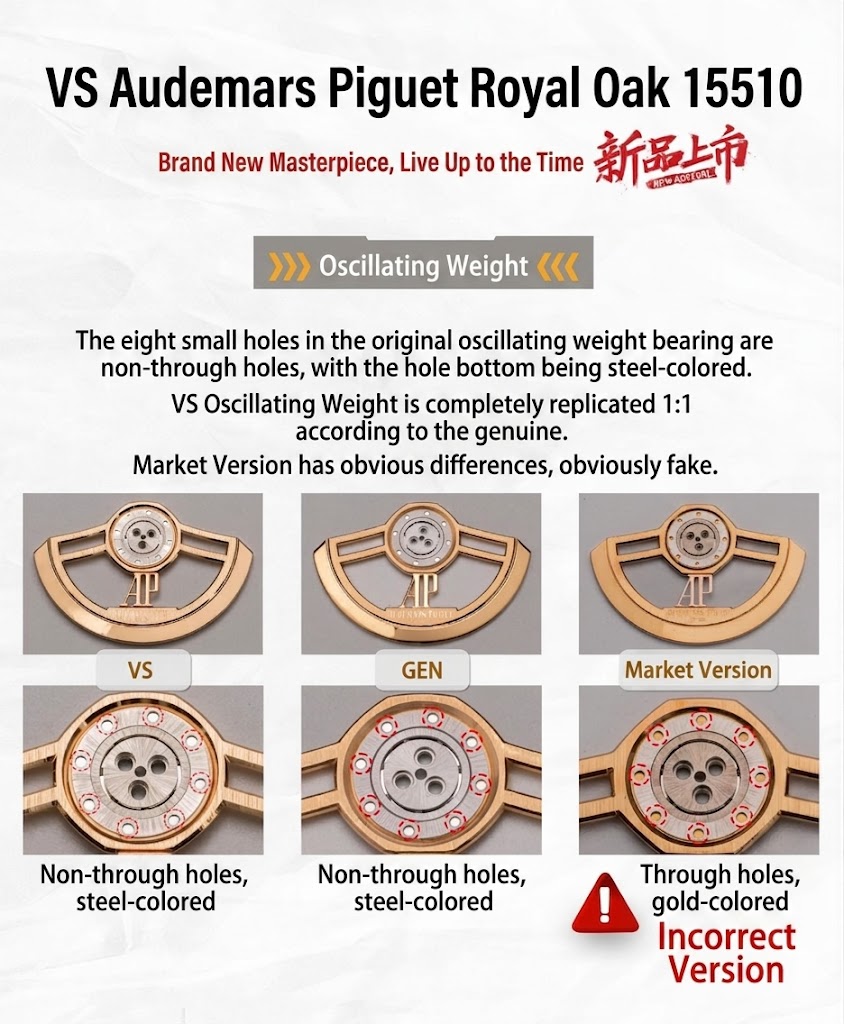
- Macro Rotor Accuracy: VSF’s attention to detail on the 22K gold-toned oscillating weight is breathtaking. Look closely at the central bearing area: the genuine rotor features 8 small circular indents that are not see-through; the bottom of these holes reveals a steel color. Market clones incorrectly made these holes hollow/see-through with a gold base, an instant visual “tell.” VSF executed this 1:1, preserving the steel-colored, non-transparent bases just like the genuine article.
2. Dial Mastery: Grande Tapisserie, Colors, and Hands
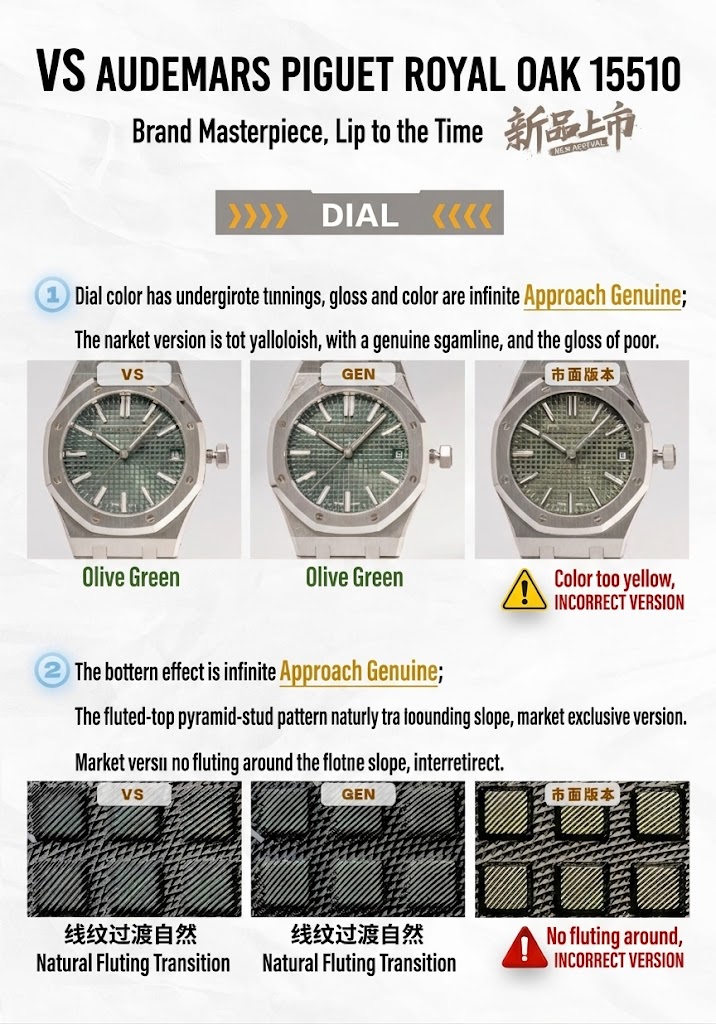
The “Grande Tapisserie” waffle dial is the soul of the Royal Oak. Reproducing its metallic sheen and intricate machining requires immense precision.
- Perfected Olive Green: After countless iterations, VSF has achieved an Olive Green dial that is infinitely close to the genuine. Market versions tend to skew noticeably yellow, lacking the rich, dynamic metallic luster of the authentic piece.
- The Sloped Waffle Transition: A massive flaw in standard clones is the outer edge of the dial. On the genuine 15510, the truncated pyramid (waffle) pattern flows naturally into the outer sloped minute track, maintaining faint textures. Market versions have a completely blank, flat sloped edge. VSF is currently the only factory to correctly replicate this natural, textured transition.
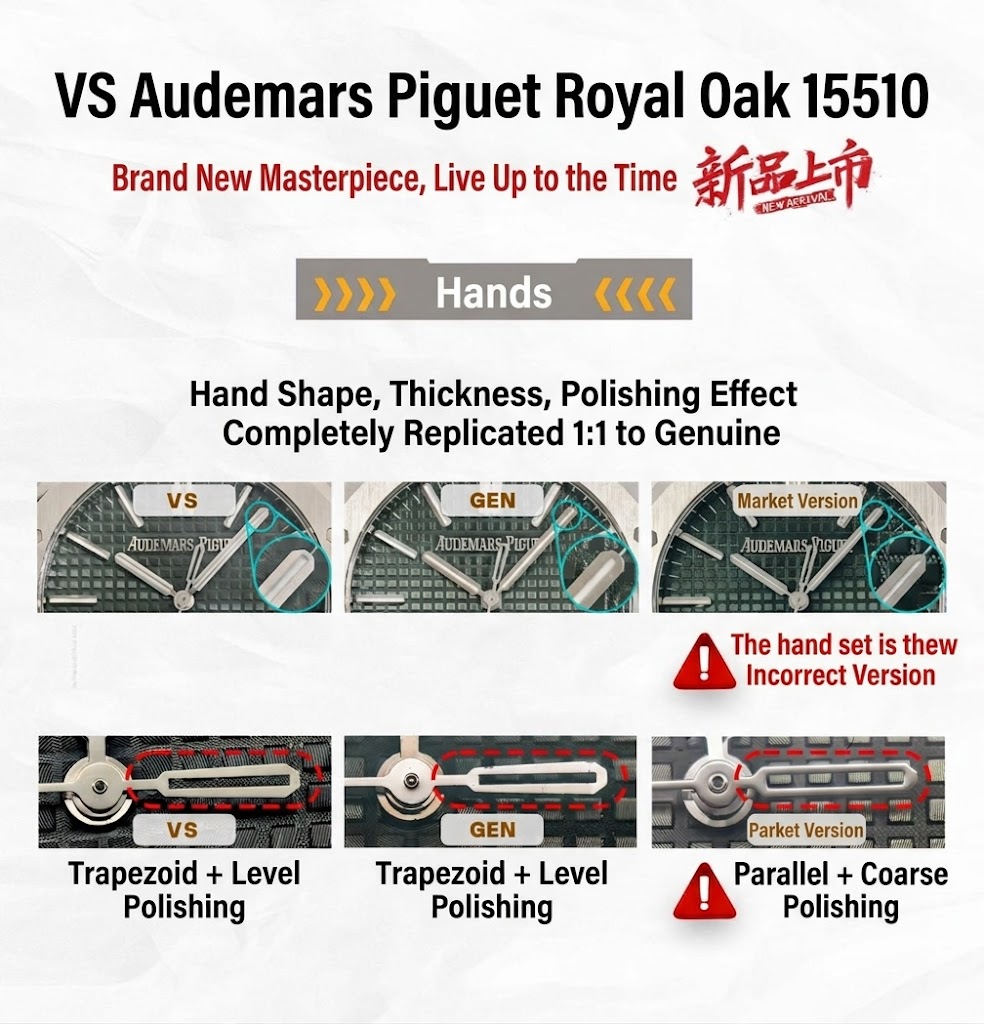
- Trapezoidal Hands Finishing: The hour and minute hands on the 15510 are broader than previous generations. VSF replicates the exact thickness and features a flawless, polished trapezoidal bevel. Competitor clones use overly thin, flat-polished hands with rough, jagged edges.
3. Case Geometry: True 15510 Tapered Lugs
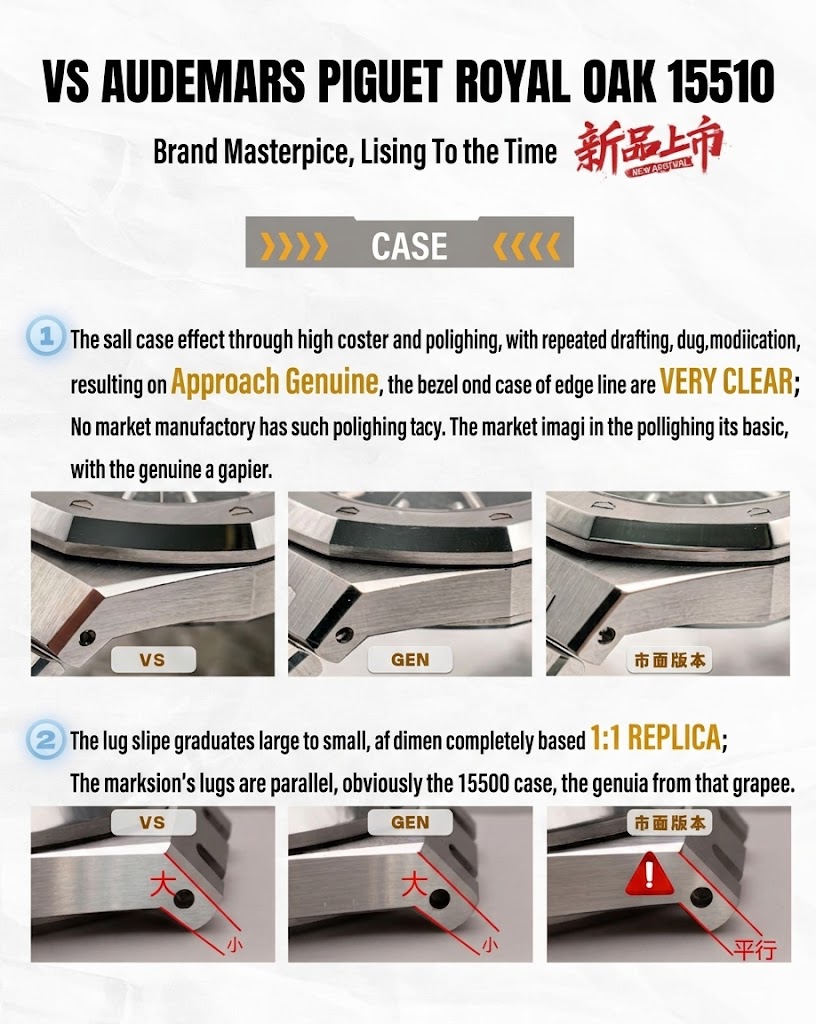
When the 15510 replaced the 15500, AP subtly refined the case for better ergonomics. Many factories ignored this and continued using old 15500 cases.
- Correct Lug Tapering: Look at the profile of the case lugs. The genuine 15510 features a lug shape that subtly tapers (wider at the top, narrower at the bottom edge). VSF cloned this shape 1:1. Standard market versions still use the old parallel, chunky lugs of the 15500.
- Superior Case Brushing: The high-cost, multi-stage brushing and polishing process used by VSF yields incredibly sharp, distinct chamfer lines along the bezel and lugs. The light play is indistinguishable from the genuine, whereas market versions look cloudy and roughly finished.
4. Bracelet Articulation & Clasp Engravings
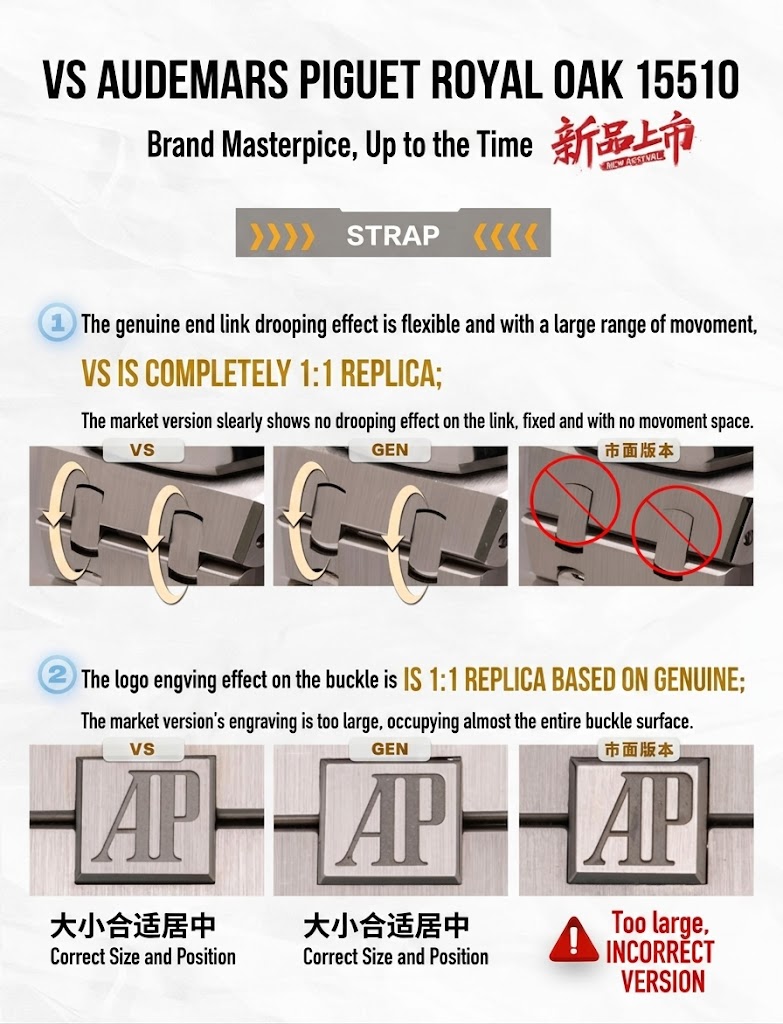
A Royal Oak must drape over the wrist like silk. If the bracelet is stiff, the illusion is broken.
- Flexible End-Links (Head Grain): The connecting links joining the case to the bracelet on the genuine watch are designed to drop downward, providing flexibility and a perfect fit on any wrist size. VSF replicates this articulation flawlessly. Competing clones have stiff, fixed end-links with zero range of motion, making the watch wear awkwardly large.
- Precision Clasp Engraving: On the folding clasp, the “AP” monogram has been refined. Market versions engrave the letters far too large, practically bleeding over the edges of the clasp square. VSF meticulously sized and centered the engraving to perfectly match the genuine 1:1 proportions.
5. Final Verdict
The VS Factory Audemars Piguet Royal Oak 15510 is not just an update; it is a complete masterclass in reverse engineering. By finally addressing the glaring movement instability with the upgraded Dandong 4302 V2, refining the case lugs to the true 15510 taper, and perfecting the articulated bracelet, VSF has effectively rendered all other market versions obsolete.
For collectors seeking the absolute zenith of AP super clones—one that passes the macro test on the dial, the flexibility test on the wrist, and the reliability test over time—the VSF 15510 is the only logical choice.