

The Art of the Scrap Rate: How VS Factory Mastered the Bi-Color Black & White Ceramic Bezel


In high-end horological manufacturing, ceramic (Zirconium Dioxide, or ZrO₂) has long been celebrated for its scratch resistance and permanent luster. However, creating a seamless, bi-color ceramic bezel insert remains one of the most punishing industrial engineering challenges in watchmaking. While the industry frequently discusses the R&D bottlenecks behind red/blue or blue/black boundaries, the stark contrast of a pure black and ivory-white split—popularly known as the “Tai Chi” or “Panda” bezel—is arguably even harder to execute without bleeding or discoloration.
Today, we peel back the curtain on the manufacturing engineering behind the VS Factory (VSF) Omega Seamaster Planet Ocean 600m GMT “Tai Chi”. Using exclusive prototyping lab images and high-resolution hands-on captures, we track the five grueling phases of trial-and-error VSF endured to eliminate impurities and establish a new market ceiling for bi-color ceramics.
📑 Table of Contents
- The Industrial Challenge of Mono-Block Bi-Color Ceramics
- The Micro-Engineering Prototyping Failures (Phases 1 to 4)
- The Technical Breakthrough: Final Formulation Dynamics
- Hands-On Evaluation: The Finished Planet Ocean GMT on the Wrist
- Technical Comparison Matrix & Structural Summary
1. The Industrial Challenge of Mono-Block Bi-Color Ceramics
A true premium bezel cannot be made by fusing two separate pieces of ceramic together; the structural joint would create an obvious structural weakness and a visible split line under macro view. It must be a single mono-block disc. Achieving this requires chemical altering or advanced multi-stage electroplating and stripping processes before or during the sintering stage. If the chemical composition or temperatures fluctuate by a fraction of a percent, the entire batch must be scrapped.
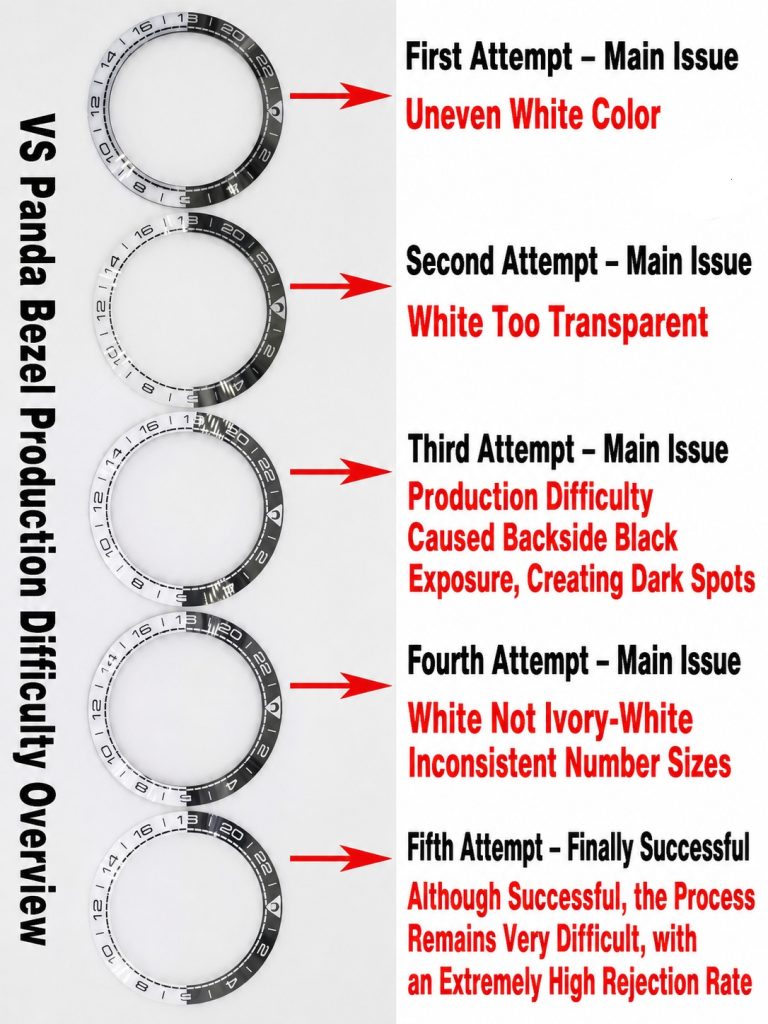
As documented in the factory production overview above, VSF faced entirely different structural defects during each prototyping phase—ranging from particle contamination to electrical conductivity failures—before successfully mastering the design language of the genuine watch.
2. The Micro-Engineering Prototyping Failures (Phases 1 to 4)
To understand the level of detail VSF invested into this component, we can analyze the evolution of their chemistry and technique through their internal macro comparisons.
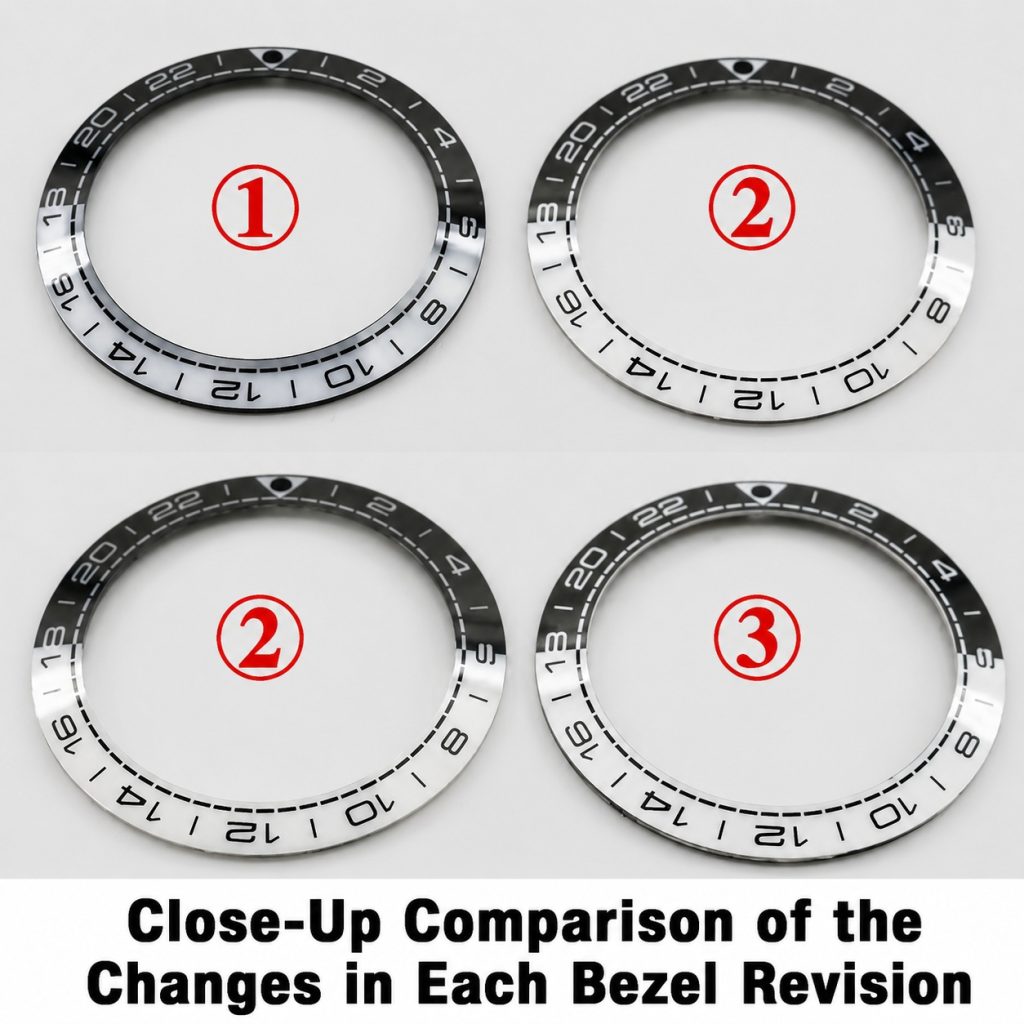
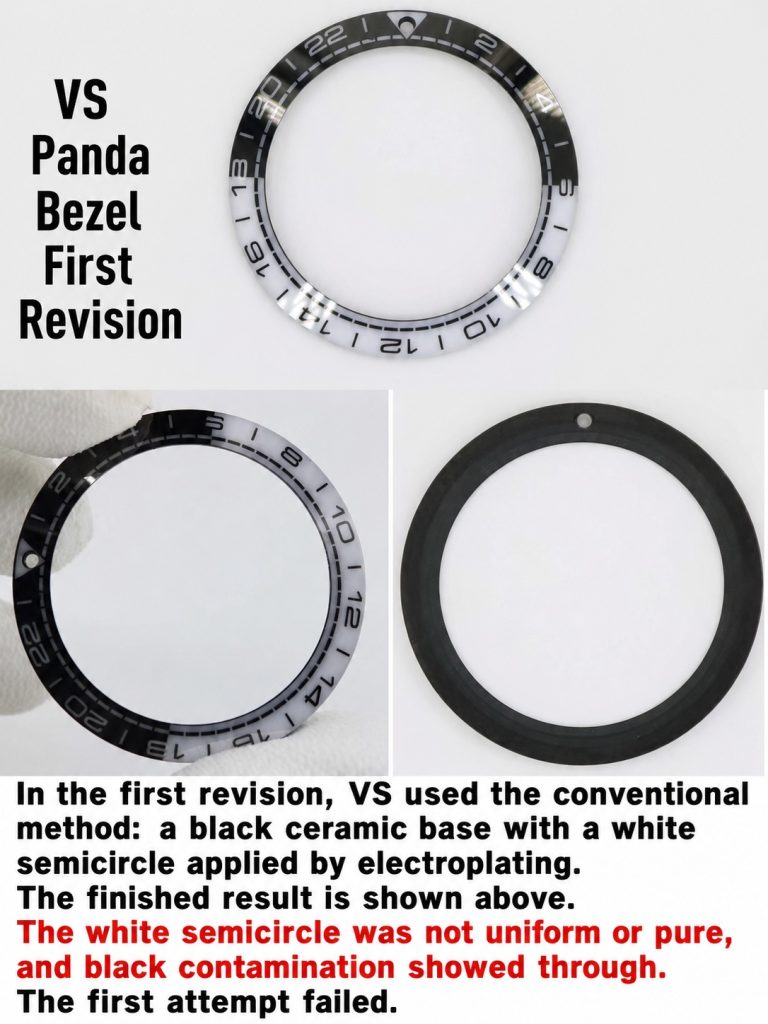
- Iteration 1 (The Black Base Method): VSF initiated development utilizing a standard black ceramic base, attempting to electroplate and strip away the white half-circle. The result was an immediate failure; the white segment was highly uneven, impure, and heavily contaminated with dark black particles.
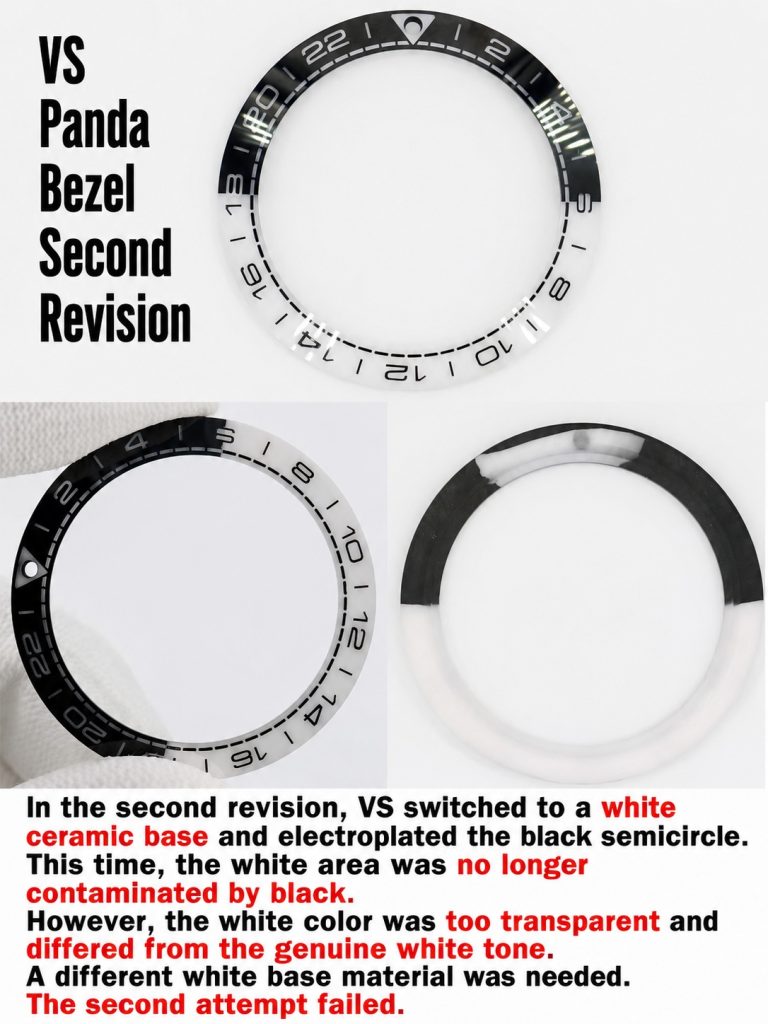
- Iteration 2 (The Translucent White Deficit): Shifting strategy, the lab swapped to a white ceramic base material, stripping away the black half. While this kept the white half free of black particle bleeding, the white compound itself emerged far too transparent and translucent. It lacked the solid, milky ivory tone required to match genuine factory specifications.
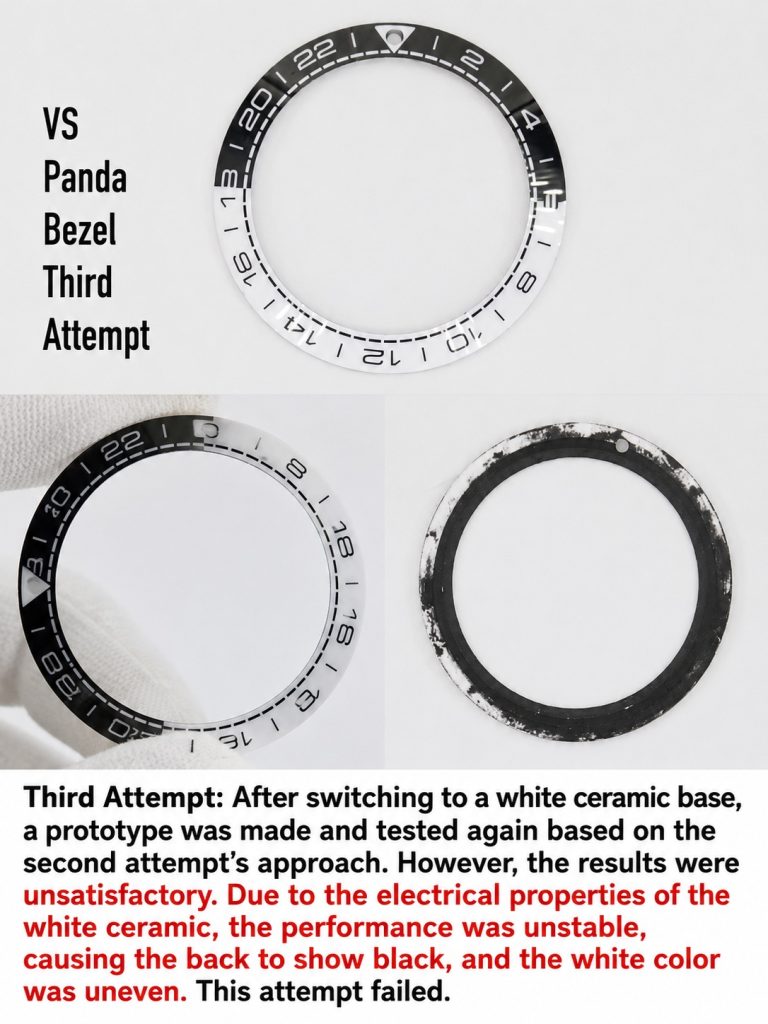
- Iteration 3 (The Conductivity Failure): To correct the translucency, VSF introduced a denser white raw base material. However, the new chemical matrix suffered from poor and unstable electrical conductivity properties during processing. This created severe black bleeding, uneven color patches, and dark spots across the reverse side of the ring.
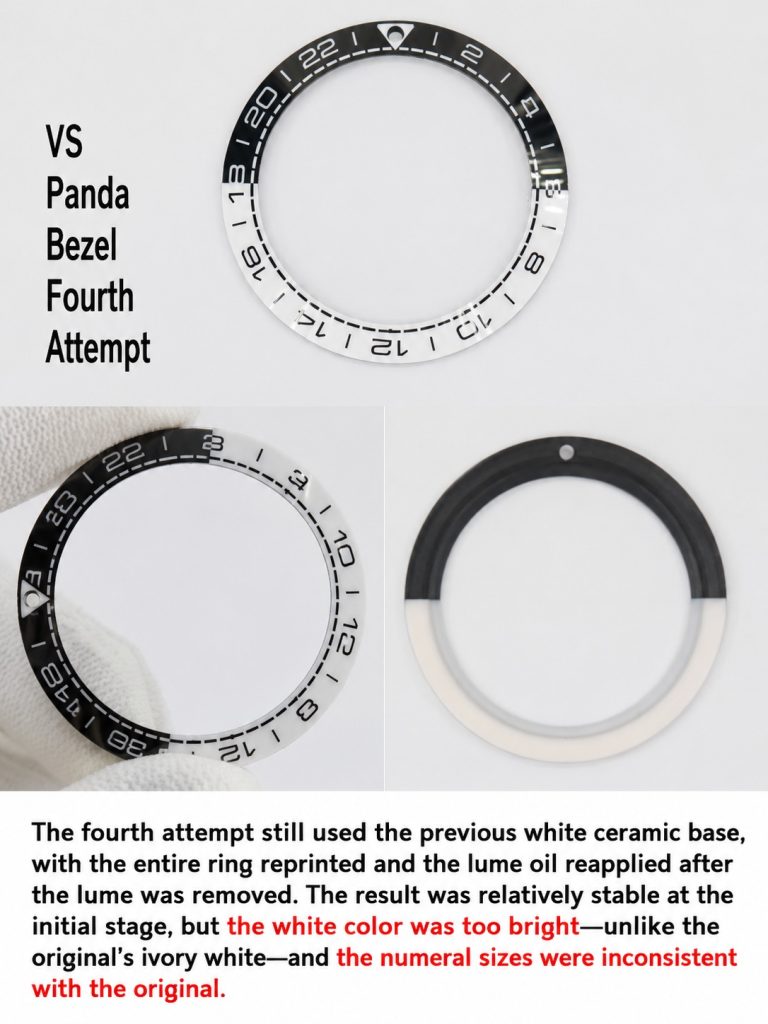
- Iteration 4 (The Stark White & Font Misalignment): Continuing with the white ceramic foundation, VSF applied full-ring electroplating followed by secondary laser stripping and specialized oil-ink masking. While the structure finally stabilized into a solid bi-color form, the white tone was artificially bright—lacking the warm ivory undertone of the original—and the 24-hour font engravings suffered from inconsistent sizing.
3. The Technical Breakthrough: Final Formulation Dynamics
Real progress is built on carefully documenting failure. On the fifth attempt, the engineering lab achieved visual parity.
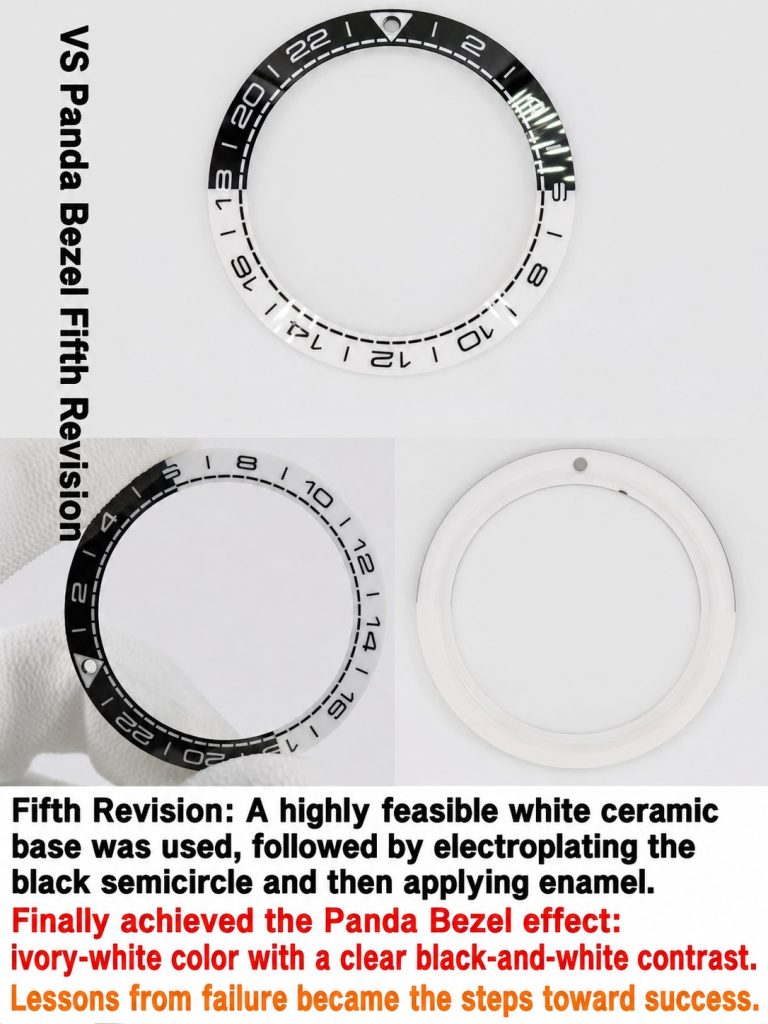
- The Successful Formula: By deploying a highly optimized, high-density white ceramic compound, VSF cleanly executed a multi-stage process: electro-stripping the black half-ring, followed by specialized high-pressure oil-ink painting. This combination successfully matched the desired ivory-white tone and contrasting black hue. Despite this manufacturing success, the complexity of managing these raw ceramic compounds means the production scrap rate remains extremely high, keeping supply limited.
4. Hands-On Evaluation: The Finished Planet Ocean GMT on the Wrist
When the finalized bi-color bezel insert is integrated into the structural assembly of the Omega Seamaster Planet Ocean 600m GMT, the real-world visual payout is immediate.
(Alt Text: Hands-on product review video capture of the VSF Omega Seamaster Planet Ocean GMT Tai Chi on the wrist)
- Perfect Visual Balance: As captured in our live hands-on evaluation, the bezel creates a perfect aesthetic harmony with the high-gloss black [ZrO₂] ceramic dial face. The color split across the 9 and 3 tracks occurs cleanly, without a fraction of a millimeter of line wandering or bleeding.
- Dial Optics and Case Ergonomics: The polished broad-arrow hands, the silver GMT pointer, and the transfers on the dial text are applied cleanly. Driven by VSF’s custom integrated Caliber 8906 movement, it achieves true GMT functionality alongside a robust 60-hour power reserve. Framed by the brushed 316L steel bracelet and robust lugs, the watch delivers a premium, heavy presence on the wrist that perfectly balances sports performance with high-end luxury styling.
5. Technical Comparison Matrix & Structural Summary
To summarize how VS Factory’s obsessive development cycle translates to tangible consumer benefits over generic market clones, we examine the final component specifications:
| Technical Metric | VS Factory “Tai Chi” Bezel (V5) | Standard Market Clones |
|---|---|---|
| Base Structure | High-Density White Ceramic (Mono-block) | Painted Steel or Fused Two-piece Ceramic |
| White Color Tone | Authentic Ivory White (Non-translucent) | Stark Plastic White / Transparent Milky Wash |
| Boundary Precision | Zero bleeding; crisp 50/50 division | Visible jagged edges and black particle bleeding |
| Font Integrity | CNC-milled, perfectly proportional 24h tracks | Inconsistent numeral sizing and uneven depth |
The VS Factory Omega Seamaster Planet Ocean GMT “Tai Chi” serves as a stark reminder that true super clones are born in manufacturing labs, not assembly lines. By refusing to compromise on the delicate color accuracy of the white ceramic base and running through 5 distinct manufacturing cycles, VSF has effectively locked down the market for this reference. For collectors who demand macro-level excellence and true material parity, this piece stands completely alone at the top of the hierarchy.
Tags: #VSFactory #OmegaSeamaster #PlanetOceanGMT #TaiChiGMT #BiColorCeramic #CeramicBezelManufacturing #SuperCloneReview #WatchHorology #VSFOmega